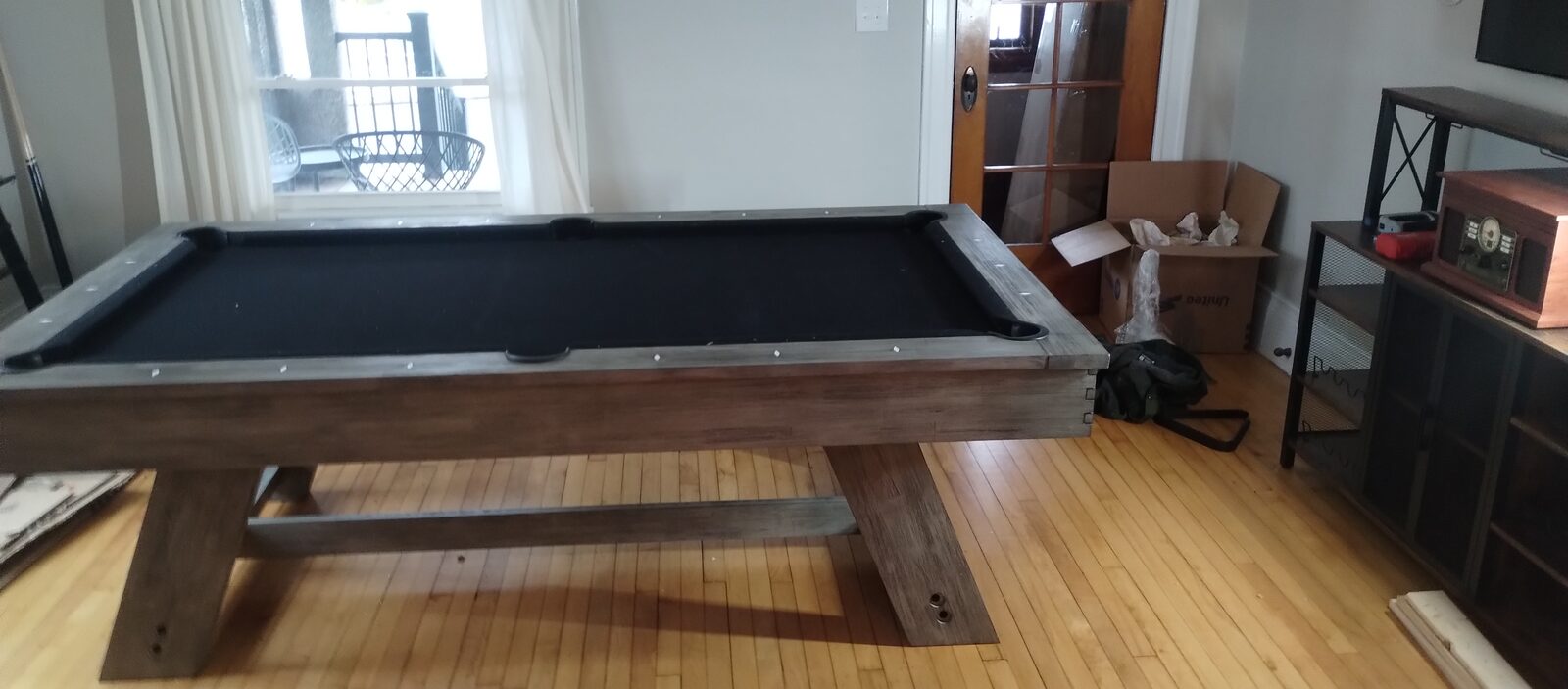
From the outside, a pool table looks like one solid piece of furniture. From the inside — once you've taken a few apart — it's a careful assembly of slate, wood, fasteners, cloth, and rubber that all has to come back together exactly right or the table won't play. This is a look at what actually happens when a slate pool table gets disassembled for transport and reinstalled at a new location.
I'm writing this less as a how-to and more as a way for customers to understand what they're paying for. There's no shortcut to doing this work properly, and the difference between a good install and a bad one isn't visible until you start playing on it.
Why slate, and why it complicates the move
Quality pool tables use slate beds because slate is dense, naturally flat, and dimensionally stable — it doesn't warp with humidity the way wood does, and it can be machined to a tolerance that wood simply can't hold. The problem is that slate is also extraordinarily heavy. A single slate piece on a standard table can weigh 200 pounds or more. Larger tables run heavier still, and the slate itself is brittle — drop it on a corner and the corner cracks off, and slate doesn't repair cleanly.
Most quality tables use three slate pieces sitting side by side rather than a single slab. The three-piece design exists specifically so the table can be moved at all. A one-piece slate is far harder to transport without damage, and once you have the table installed, it's effectively a permanent fixture of the room until somebody disassembles it again.
The disassembly sequence
Disassembling a slate table is essentially the install process in reverse, but with one critical difference: the cloth almost never survives in reusable condition unless the slate is staying together as a unit. (More on that in a minute.)
The order of operations:
1. Pockets come off first. They're typically attached with screws through the rails or bolts into the slate itself. Pocket leather and netting can deteriorate with age and sometimes need replacement at this stage.
2. Rails come off. The rails — the wooden frames around the perimeter that hold the bumpers — are bolted to the slate from underneath. The bolts get backed out in a specific cross-pattern (similar to torqueing lug nuts on a wheel) so the rails come off evenly without warping. The bolts and any spacers get bagged and labeled because every table is slightly different, and re-using the original hardware is faster and more reliable than substituting new.
3. Cloth comes off. If the cloth is going to be reused, this is where it gets carefully separated from the slate.
4. Slate seam wax gets cleaned up. The wax or beeswax filler that bridges the slate seams gets scraped out so the slate pieces can be separated cleanly.
5. Slate pieces come up. This is the heaviest part of the job. Each slate piece gets lifted off the frame, padded, and either crated for long-distance transport or wrapped and prepared for a short move. Slate corners are the vulnerable part — most of the damage we see on used tables is chipped corners from previous moves where the slate was set down too hard.
6. Frame and legs come apart. The wooden frame and legs typically break down into manageable sections. The hardware gets bagged with the rail hardware so everything stays organized.
From there, the components get loaded for transport in a specific order — heaviest pieces (slate) get loaded last so they come out first at the destination, which keeps them on the truck for the shortest time.
What the leveling process looks like
I mentioned in the previous post that leveling is the most critical part of an install. It's worth explaining why, because it's the part most customers don't see and don't think to ask about.
A pool table needs to be level in three different senses:
- End-to-end level — the table can't tilt from one end to the other.
- Side-to-side level — the table can't tilt from one rail to the other.
- Slate piece coplanarity — the three slate pieces have to all sit in exactly the same flat plane. If one piece is even slightly higher than the others, balls will roll across the seam differently in different directions.
The tolerance is tight. A precision machinist's level — the kind used for setting up machine tools — is the right instrument for the job. A regular bubble level from a hardware store can only resolve to about 1/16 inch over its length, which sounds fine for hanging pictures but is way too coarse for pool. A machinist's level resolves to thousandths of an inch, and that's the resolution you need to get a table playing right.
Why this matters for play
On a slightly off-level table, balls won't follow straight lines — they curve toward the low side. Most people can't see this with their eyes, but they can feel it when they play. Shots that should drop don't. The table feels "wrong" without the player being able to articulate why. A properly leveled table feels honest. The ball goes where the cue tells it to go, and that's the whole point.
The reinstall
Reinstallation follows the disassembly steps in reverse, with the leveling step being where most of the time goes. New cloth, if needed, gets stretched and stapled. Rails go back on with the bolts torqued in the correct cross-pattern. Pockets reattach. Final level check.
From start to finish on the install side, a standard reinstallation runs about 1.5 to 2 hours assuming the cloth situation is straightforward. New cloth adds time. Custom cloth, custom cushions, or any complication discovered during disassembly (warped slate, cracked frame, missing hardware) adds time too.
What can go wrong, and how we avoid it
The most common problems on a pool table move:
- Chipped slate corners from rough handling during transport. Avoided by padding and crating slate pieces individually rather than stacking them.
- Lost or mismatched hardware. Avoided by bagging and labeling everything as it comes off the table — every bolt goes back in the hole it came out of.
- Warped rails from uneven bolt removal or storage in damp conditions. Avoided by using the cross-pattern on the bolts and storing rails on edge rather than flat.
- Torn cloth from attempting reuse when the cloth wasn't a good candidate. Avoided by being honest with customers up front about whether reuse is realistic.
- Improperly leveled reinstallation. Avoided by using the right leveling instrument and not rushing the leveling step.
None of these are catastrophic if they happen — slate corners can sometimes be touched up, hardware can be replaced, rails can be straightened. But the right approach is to do the work properly the first time so the table comes out of the move playing the same as it played before.
The bottom line
A slate pool table move is a careful, multi-stage job that rewards patience and punishes shortcuts. When you hire a third party specialist for the work, what you're paying for is the experience to know what each step requires, the tools to do it correctly, and the discipline to not skip the slow parts. The visible result is a table that looks the same after the move as it did before. The invisible result — and the one that matters more — is a table that plays the same after the move as it did before.